

A custom website is designed and coded from scratch for your business; a template website starts from a pre-made design or theme that you fill with your own content. Both can be built professionally, which is the point most comparisons miss: choosing a template does not mean building it yourself, and choosing custom does not guarantee a better result. The real question is not which is “better” in the abstract, but which fits where your business is right now and where it is heading.
One boundary before we start. This article is about how your site is built: a pre-made template or a custom build. Who builds it, whether that is you or a professional, is a separate decision. If you are still weighing that up, read our guide to DIY vs hiring a professional. Here we assume you are investing in a proper website and want to know which build approach earns that investment.
Key Takeaways
- A template and a custom website can both be professionally built; the real differences are design uniqueness, launch speed, performance, SEO control, scalability and maintenance.
- A template is enough when you are validating a business, working to a tight budget, need to launch fast, or only need a simple informational site.
- Custom starts to pay off when the website directly drives revenue, you need functionality a template cannot provide, SEO and performance are priorities, or you plan to grow without rebuilding.
- Most small businesses take a hybrid path: launch on a template to validate, then invest in custom once the template becomes the bottleneck.
- Treat precise ROI and conversion figures in comparison articles with suspicion; they are rarely backed by a published method.
What’s the Actual Difference Between a Custom Website and a Template?
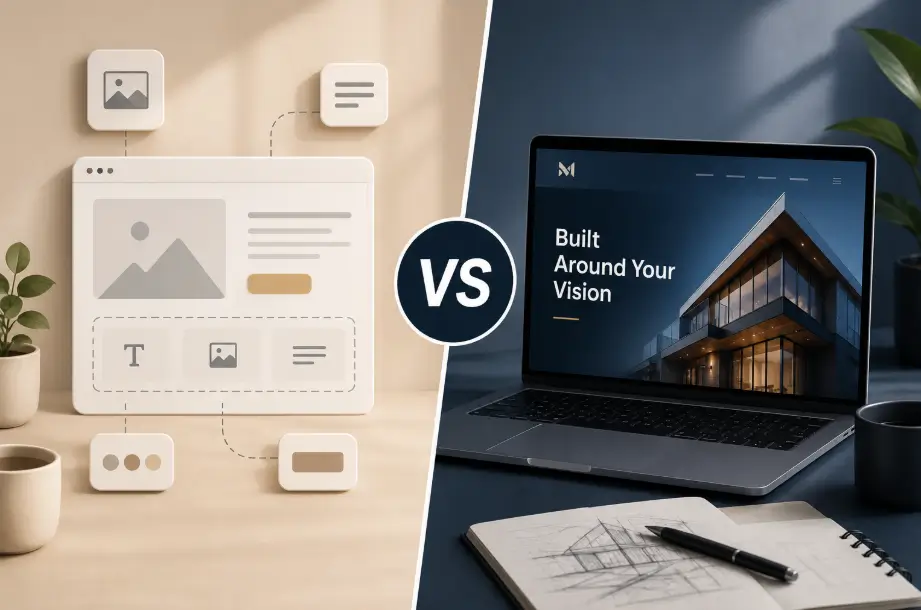
A custom website is built specifically for you: a designer plans the layout around your content and goals, and a developer writes the code to match. A template website starts from a pre-designed theme, such as a WordPress theme, a Shopify theme or a Squarespace layout, and your text, images and branding are placed into that existing structure.
Two clarifications matter here. First, a template is not the same as a DIY website. A professional can take a quality theme and customise it heavily, so “template” describes the starting point, not who does the work. Second, custom is not automatically better. A well-chosen template with strong content and imagery will outperform a poorly executed custom build. As Elementor’s own comparison of the two approaches notes, the right choice depends on your goals, budget and stage of growth rather than on one option being universally superior (Elementor: Custom Website vs Template). With that in mind, here is where the two genuinely differ.
Custom Website vs Template: The 6 Things That Actually Differ
Strip away the marketing and the two approaches differ on six dimensions. None of them is a reason to dismiss either option outright; they are trade-offs to weigh against your situation.
| Factor | Template | Custom |
|---|---|---|
| Design uniqueness | Pre-made layout other businesses may share | Designed and built for your brand |
| Launch speed | Days | Weeks to months |
| Performance | Can carry unused code that slows pages | Built lean for your specific needs |
| SEO control | Limited by the theme structure | Full technical control |
| Scalability | Can become restrictive as you grow | Designed to grow with you |
| Maintenance | Theme and plugin updates | Needs ongoing developer support |
A few of these deserve a word of context. On performance and SEO, a bloated theme can hurt the speed and mobile experience that conversion depends on, which is exactly the territory our mobile UX conversion guide covers in detail. On scalability, the issue is not that templates cannot grow, but that they can become harder and more expensive to stretch as your requirements get specific. And on maintenance, a template relies on the theme vendor keeping it updated, while a custom site relies on having a developer you can call.
When a Template Website Is Enough
If any of the following describe you, a good template website is probably all you need, and paying for custom development would be money spent before it is useful.
A template makes sense when you are validating a new business or idea and want to test demand before committing heavily. It makes sense when the budget is tight, when you need to launch within days rather than months, and when the site is largely informational: your services, a contact page, an about page. It also makes sense when your content rarely changes, because you will not feel the limits of a fixed structure.
On cost, a template route has a clearly lower upfront spend than a custom build, though the exact figure depends on your needs. We keep pricing out of this article on purpose; for realistic numbers see our affordable web design guide. If a fast, affordable, professionally built template site sounds like your stage, that is precisely what our small business website development service is built for.
When a Custom Website Is Worth It
Custom development starts to earn its higher cost when the website is not just a brochure but a working part of how you win and serve customers.
Custom is worth serious consideration when the site directly drives sales or enquiries, because small gains in performance and conversion then carry real revenue. It is worth it when you need functionality a template cannot provide, such as a booking system, a customer portal, a dashboard or integration with your existing tools. For an in-depth breakdown of when a business needs APIs, portals or integrations, we cover the exact operational decisions before asking for a quote. It also matters when SEO and performance are genuine priorities, since custom gives you full technical control over both. And it makes sense when you plan to grow over years and would rather build once on a solid foundation than rebuild out of a limiting theme later.
If that sounds like your situation, our custom website development service is the relevant next step, and our guide to choosing a web designer will help you pick the right partner for it.
The Hybrid Path Most Small Businesses Take
In practice, most small businesses do not choose one approach forever. They phase it, and that is usually the sensible move.
The common pattern looks like this. Stage one: launch on a template to get online quickly and cheaply, and to learn what your customers actually respond to. Stage two: the business gains traction, and the template starts to chafe, because you need a feature it does not have, the performance ceiling is showing, or the generic look no longer matches a growing brand. Stage three: you invest in a custom build on the foundation of a business you have already proven. This is exactly how we structure our own work, with template-based sites for a fast, affordable start and custom development when you are ready to scale.
Phasing the spend this way also spreads the cost over time. We keep figures out of this article, but if you want to plan the budget across stages, our web design budget guide walks through how to think about it.
How to Decide: A Simple Framework
If you want a quick way to locate yourself, answer four questions honestly.
First, does your website directly bring in revenue or enquiries? Second, do you need functionality a template cannot give you? Third, do you plan to run and grow this business for the long term? Fourth, is a distinctive brand a genuine competitive factor in your market?
If you answered yes to most of these, a custom website is likely worth the investment. If you answered no to most, a template will serve you well for now. If you are somewhere in the middle, the hybrid path, starting on a template and upgrading when it becomes the bottleneck, is usually the right call. This framework tells you the direction; for the dollars, our cost guides in the affordable web design and budget articles carry the numbers.
Custom Website vs Template: Myths and Marketing Spin
Most articles on this topic are written by someone selling one of the two options, so a few recurring claims deserve scrutiny before you let them sway you.
”Template sites all look the same and look cheap.” A quality template with strong copy and good imagery can look thoroughly professional. The generic look comes from neglect, not from the template itself.
”Custom always ranks and converts better.” Rankings and conversions depend on execution: content, technical SEO, speed and mobile experience. Custom gives you more control over those levers, but control is not the same as a guaranteed result.
Precise ROI and conversion figures. You will see claims like a four-figure percentage ROI or a specific conversion-rate gap between custom and template sites, often with no published method behind them. One Australian agency’s comparison page, for example, presents exactly this kind of precise figure without showing how it was calculated (Sites By Design). Treat any such number as a sales argument, not evidence.
”A template ends up costing more over five years.” This is only true if you genuinely needed custom functionality all along. For a simple informational site, a template remains the cheaper option over any timeframe. The honest answer depends on your business, not on an article with something to sell.
Frequently Asked Questions
Is a custom website better than a template?
Neither is universally better. A custom website is worth it when the site directly drives revenue, you need functionality a template cannot provide, SEO and performance are priorities, or you plan to grow without rebuilding. A template is enough for validating a business, a tight budget, a fast launch or a simple informational site. Most small businesses start on a template and move to custom later.
Is a template website the same as building it myself?
No. A template describes the starting point, a pre-made design or theme, not who does the work. A professional can customise a quality template heavily. Whether you build it yourself or hire someone is a separate decision covered in our DIY vs hiring a professional guide.
Will a custom website rank better on Google?
The build route itself does not determine rankings. Execution does: content quality, technical SEO, page speed and mobile experience. Custom development gives you more technical control over those factors, but a well-executed template site can outrank a poorly built custom one.
When should I upgrade from a template to a custom website?
Upgrade when the template becomes the bottleneck: you need functionality it cannot provide, you have hit its performance or SEO ceiling, your brand has outgrown the generic look, or the website has become a meaningful source of revenue that justifies the investment.
How much more does a custom website cost than a template?
A custom build has a clearly higher upfront cost than a template route, but the exact figure depends on your requirements. We keep pricing out of this article deliberately; for realistic numbers see our affordable web design guide and web design budget guide.
Conclusion
Custom and template are both legitimate, professionally built routes, and the right one depends on your business, not on which article you last read. Ask yourself the four questions: does the site drive revenue, do you need functionality a template cannot give you, are you in it for the long term, and does brand distinctiveness matter in your market. Most small businesses land on the hybrid path, launching on a template and investing in custom once the template starts to hold them back. If you would like a straight recommendation, we build both and can tell you honestly which fits. Talk to our Adelaide team. Bilingual English & Chinese support.
