

If you have ever been told “just make a Facebook Page, you do not need a website,” this article is for you. For a small business owner the question is practical: should I invest in a website, or will posting on social media be enough to bring in customers? The answer matters because it decides where you put your time and money for years.
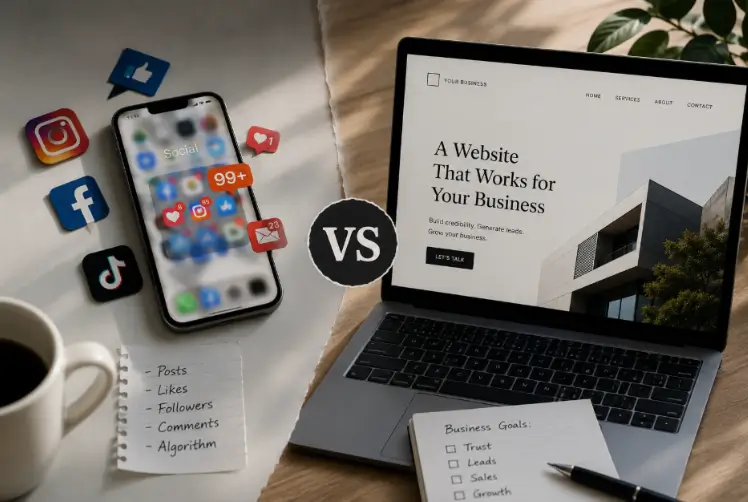
The short version up front. A website is an asset you own; social media is a channel you rent. Both are useful, but they are not alternatives to each other. For most small businesses the answer is not “website or social media” but “own the front door, and let social media drive people to it.” This guide explains the difference in plain terms, when social media alone genuinely is enough, and how to decide for your business.
Key Takeaways
- A website is an owned asset; social media is a rented channel. Platforms change their algorithms and can suspend accounts, but your website and its content remain yours.
- The Australian government describes a business website as your “digital front door” and tells you to promote it across your channels, explicitly including social media. The official view is that the website is the base and social media drives traffic to it, not either-or.
- A website gives you things social media cannot: credibility, a dedicated conversion page, being found in search, and customer data you actually own.
- Social media alone is only enough for a small set of businesses, typically very early validation or personal, referral-driven services.
- For most local small businesses the pattern is: have the website, then let social media push people to it.
Why the Question “Social Media or Website” Keeps Coming Up
Because social media looks free and a website looks expensive. Setting up a Facebook or Instagram page takes minutes and costs nothing, while a website takes time, money and decisions. If you are starting out or your budget is tight, that contrast is seductive, and platforms actively encourage small businesses to open a free page.
What the “free” framing leaves out is what you are trading. On social media you rent the audience: the platform sets the rules, changes its algorithm, and can restrict or suspend your account. You build up followers, but you do not own the relationship or the data behind them. A website is the opposite: you own the domain, the content and the connection with visitors who come to you directly. That is the trade-off at the centre of this whole question, and it is the reason the two are not interchangeable.
What You Own vs What You Rent
Put simply, a website is an asset you own, and social media is a channel you rent. Everything else in this article follows from that difference.
| Dimension | Your website (owned) | Social media (rented) |
|---|---|---|
| Who sets the rules | You do | The platform algorithm |
| Does your content disappear | Only if you remove it | Platform changes or an account suspension can take it away |
| Your customer data | Yours, via forms and email | The platform’s, and followers are “borrowed” |
| What compounds over time | Domain, SEO and content build value | Needs constant feeding; a rule change can reset it |
| Upfront cost | Design, build and hosting | Free to join, with ongoing time and ad spend |
This is not a criticism of social media. It is a description of how the two differ, so you can choose knowingly. The Australian government’s own guide to setting up a business website puts the relationship plainly: a website is “an important part of your business’s online presence,” a good website “makes you look more professional” and “makes it easy for customers to find and contact you,” and the guide calls your website “the digital front door to your business” that you should “promote it across your channels,” adding that this includes “your social media platforms and email newsletters” (business.gov.au, set up a business website).
Read that again: the government calls the website the front door and lists social media as a channel that promotes it. That is the hierarchy. Social media is not a replacement for the front door; it is one of the ways people find out that the front door exists.
Who owns what also matters legally and practically. Your website’s content, domain and visitor relationships belong to you. A social media profile is subject to the platform’s terms, and a suspended account can remove years of posts in one day. Our guide to who owns your website walks through exactly what you keep when you build a site, which is worth understanding before you decide.
What a Website Gives You That Social Media Cannot
A website earns its cost in four ways that a social media page cannot match: credibility, a dedicated conversion surface, being found in search, and customer data you own.
Credibility. When a customer is comparing you, they search for you, and a professional website tells them you are a real, established business. The government guide puts it as looking “more professional” and making it easy for customers to “find and contact you.” A Facebook page can do some of this, but it reads differently to a customer making a considered decision, especially for services where trust decides the sale.
A dedicated conversion surface. A social media post is not built to capture an enquiry. A website page is: clear message, a call to action, a contact form, everything arranged to move a visitor to act. This is why a website is usually the place enquiries actually happen. If your site is not turning visitors into enquiries, that is a fixable problem; our guide to traffic without leads diagnoses exactly where the drop-off happens.
Being found in search. If someone in Adelaide searches for your kind of service, in the vast majority of local searches they see businesses with a web presence, not social media profiles. Local SEO depends on a website with locally-focused content, as our local SEO guide explains. No website means you are not even a candidate for that search.
Data you own. Every visitor who fills your form or subscribes to your email list is a relationship you control. A follower on social media is data the platform controls, and it can change the rules at any time. The difference between “you own the audience” and “you rent the audience” is the difference between a business asset and a marketing expense.
What Social Media Does Better
Social media is not the enemy. It is genuinely better than a website at three things, and those three things are worth having.
Being discovered. A brand-new business has no search authority and no word of mouth. Social media can put you in front of local people quickly, especially with shares, tags and community groups. It is the fastest way to get seen when you have nothing else.
Showing you are human. Customers buy from people they trust. Social media lets you show products, behind the scenes, answers to questions and a personality in a way a brochure-style website cannot. That warmth builds the “this is a real business” feeling that precedes a decision.
Cheap experimentation. Posting costs almost nothing, so you can test what your customers respond to before you invest more. It is a low-risk place to learn your market’s language.
Notice what all three have in common: they create attention. Social media is excellent at pulling attention toward you. The question is what happens to that attention when it arrives. A social media page is a rented room; a website is the place you can actually turn attention into enquiries, and keep the relationship. For specific community platforms — such as reaching Chinese-speaking customers via Xiaohongshu marketing in Australia — the same principle applies: use the channel for discovery, but route high-intent leads back to your own web infrastructure. For a detailed look at how channels like SEO, Google Ads and AI fit together once you have a site, our guide to SEO vs Google Ads vs AI covers the full picture.
When Social Media Alone Is Actually Enough
There is a small set of situations where starting with social media only, and skipping the website for a while, is a reasonable choice. The test is not about effort; it is about whether your customers need credibility, search or a place to enquire.
Social media alone works when you are validating a brand-new idea and want to test demand before spending money, and when your customers already know you, come through referrals, or buy on impulse with no comparison stage. Examples are personal services like mobile nail care or tutoring sold through personal networks, and very early product tests where you just want to see if anyone bites. In those cases a social media page is a fine starting point.
But even then, it is a starting point, not a permanent home. For a business that needs customers to find it, compare it and trust it, social media alone is not enough, and that covers most trades, retail, professional services and clinics. A related note: for local visibility, many small businesses benefit most from a Google Business Profile before anything else. Our guide to Google Business Profile Adelaide covers that piece; the point here is simply that social media and a website answer different questions than a profile does.
The Real Answer: Own the Front Door, Rent the Shopfront Traffic
For most local small businesses the honest answer is: have the website as your owned front door, and use social media as the rented shopfront that brings people to it. They are a pair, not competitors.
Here is the pattern in practice. Your website is the front door: it states what you do, who it is for, and how to get in touch, and it is the place where attention becomes an enquiry. Your social media is the foot traffic outside: it gets you seen, builds trust and reminds people you exist. The two connect when a social post links to a website page, or when people who found you on social search your name and land on your site to check you are real.
This also holds for bilingual business owners in Adelaide. If you serve Chinese-speaking customers, the people who refer you on WeChat or in community groups will still search for you before they commit, and a website in both English and Chinese answers that check in a way a social page cannot. It is a small investment that signals you are established on both sides.
None of this is a pitch for a big website. A simple, honest site is enough to be the front door; the cost question is a separate one, and we keep pricing out of this article on purpose. For realistic numbers see our affordable web design guide.
A Simple Way to Decide
If you are unsure where you land, answer three questions honestly.
First, would a customer search for you or compare you with a competitor before buying? If yes, you need a website, even a simple one, because without it you are invisible to that search and you lose the comparison.
Second, can you accept that a platform rule change could affect your reach, or even your account? If that risk would hurt, you need an owned asset that is not subject to someone else’s algorithm. That is the website.
Third, are you validating a new idea, or building a long-term business? If you are testing demand, social media alone is a fine first step. If you are building something you plan to run for years, the website should come, because it is the asset that compounds.
If you answered “yes” to the first two and “long term” on the third, start with a simple website and use social media to drive people to it. If you are still early and unsure, start on social media, get your first few customers, and add the website once you know what you are selling and to whom. For the build itself, whether you take it on yourself is a separate decision covered in our guide to DIY vs hiring a professional.
Frequently Asked Questions
Do I need a website if I have a Facebook Page?
If your customers search for you, compare you, or need a place to enquire, yes. A Facebook Page is a rented channel: the platform owns the audience and can change the rules. A website is an asset you own. For most local small businesses the practical answer is to have both, with the website as the front door and social media driving people to it.
Can I just use Instagram to sell?
You can start selling on Instagram, and many small businesses do. But Instagram is a traffic entry point, not a place where you own the customer relationship or the data. For a business you plan to run long term, you will eventually need a place of your own to convert attention and keep the relationship.
Is social media cheaper than a website?
Social media is free to join, but it costs time to post, and reach often depends on paid ads, so the ongoing cost is real and recurring. A website has an upfront cost, then a relatively small monthly cost, and it compounds through search and owned content. Once time and recurring ad spend are counted, many small businesses find a simple website the cheaper option over several years. For realistic numbers, our affordable web design guide carries the figures.
Do social media and a website work together?
Yes, and the Australian government’s guide describes exactly how: the website is “the digital front door to your business,” and you “promote it across your channels,” including “your social media platforms and email newsletters.” Social media brings attention; the website converts it and keeps the relationship.
What is the difference between a Google Business Profile and a website?
A Google Business Profile is how you get found in local search and on Google Maps; a website is the owned front door that converts visitors and gives you an asset you control. They answer different questions, and a small local business often benefits from both. Our guide to Google Business Profile Adelaide covers the profile side in detail.
Conclusion
A website is an owned asset; social media is a rented channel. Both have real value, but they are not alternatives. For most local small businesses the pattern is to own the front door and let social media drive people to it, because the website is where credibility, conversion, search visibility and customer data actually live. If you are very early and just testing demand, social media alone is an acceptable start, but treat it as a stepping stone, not a long-term home. When you are ready to build the asset that keeps paying off, explore our integrated social media management services and talk to our Adelaide team. Bilingual English & Chinese support.
