

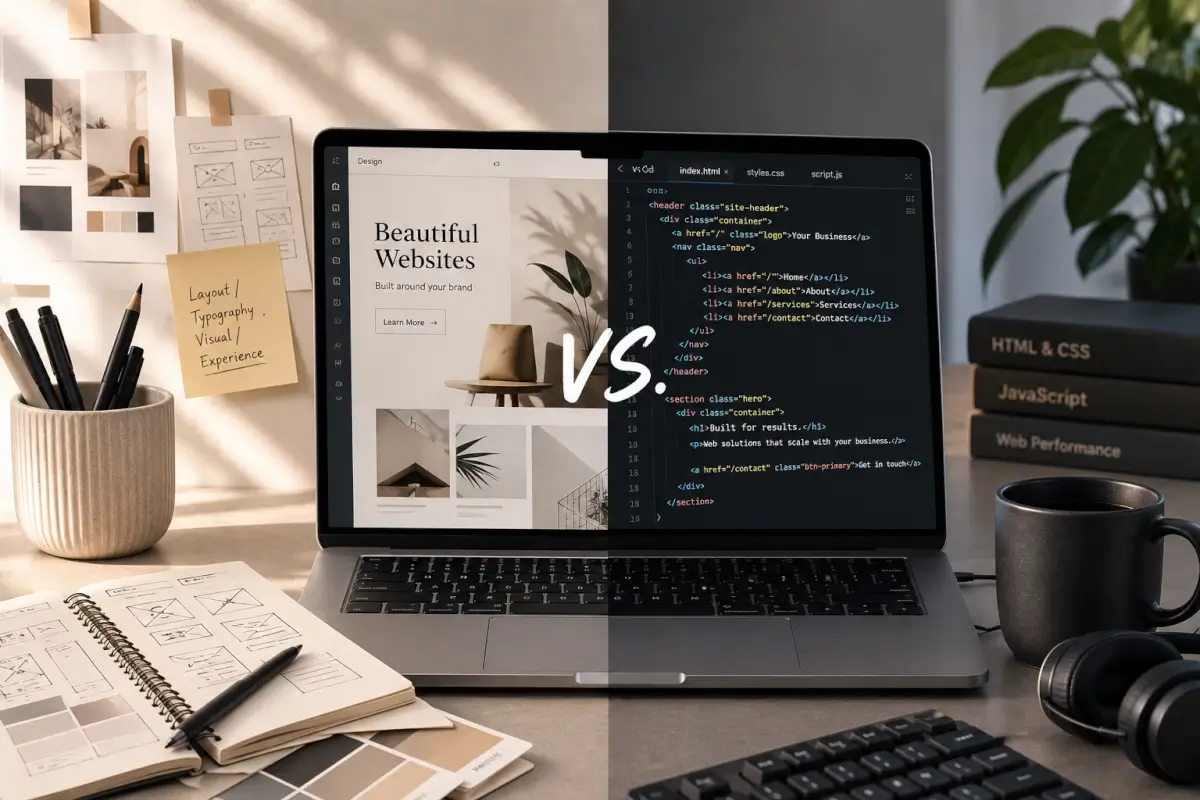
A web designer creates the visual design and user experience of a website; a web developer builds its structure and functionality, turning that design into working code. That is the clean definition, and it is accurate as far as it goes. But if you are a small business owner trying to work out who to hire, the definition is only half the answer, because the two roles overlap far more in practice than the titles suggest.
This article explains what each role actually does, where the line blurs for small business projects, and how to decide who you need. One boundary before we start: this is about the roles a person fills, not the delivery model you choose. Whether you hire a freelancer or an agency is a separate decision covered in our freelancer vs web design agency guide.
Key Takeaways
- A web designer owns the visual design and user experience; a web developer owns the code, structure and functionality.
- The roles are clearly defined in theory but overlap heavily in small business projects, where one person or small team often does both.
- Most small businesses do not need to hire a separate designer and developer; they need a team that covers both sides.
- Decide by need: a brand-led site leans on design, a functionality-heavy site leans on development, and most small projects need a hybrid.
- Evaluate any candidate by their real work, not their job title.
What’s the Difference Between a Web Designer and a Web Developer?
In the simplest terms, the designer decides how the site looks and feels, and the developer makes it actually work. Coursera’s comparison defines it directly: web designers “create the visual design and user experience of a website”, while web developers “build its structure and functionality”, taking a designer’s vision and converting it into code (Coursera: Web Designer vs Web Developer). HubSpot makes the same split from a hiring perspective: a designer “builds the visual appeal for a website”, while a developer “writes code and builds the back-end functionality” (HubSpot: Web Designer vs Web Developer).
Both definitions point the same way: design is about how a site communicates, and development is about how a site works. Everything below unpacks what each side involves, and then addresses the question that matters more for a small business: who should you actually hire?
What a Web Designer Does
A web designer decides what a website looks like and how easy it is to use. As Coursera puts it, designers “focus more on the creative aspects” of a site (Coursera).
That covers the visual design: colour, typography, spacing, imagery and layout. It also covers the user experience: how a visitor moves through the site, whether the next action is obvious, and whether the design guides them towards calling you or submitting a form. Designers work with brand guidelines, keep the site consistent across pages, and consider how the experience feels on a phone rather than just a desktop monitor. Accessibility, readable text and sensible contrast also fall under their remit.
If your website exists mainly to present your business, look credible and feel right to your customers, the design side is doing most of the heavy lifting. Choosing who builds it well is a separate question, and our guide to choosing a web designer walks through the process.
What a Web Developer Does
A web developer turns the design into a working website. Where a designer cares about how something looks, a developer cares about whether it functions correctly, loads quickly and stays secure. HubSpot’s definition is direct: developers “write code and build the back-end functionality” (HubSpot).
Development splits into front-end, the code that makes what the visitor sees work in the browser, and back-end, the servers, databases and logic that power features behind the scenes. A developer handles the contact form that actually delivers, the booking system that takes a reservation, the page that loads fast on mobile, and the security that keeps the site from being compromised. If you need e-commerce, a customer portal or integration with your business tools, that is squarely development territory.
If your site needs to do more than present information, if it has to take bookings, process payments or connect to your systems, the development side is what makes or breaks it. The kinds of functions a converting site needs are covered in our guide to website design that converts.
The Grey Area: Most Small Businesses Hire a Hybrid
Here is the part that matters most. In a large company, designers and developers are separate people with separate specialties. In a small business project, the person you hire is usually both at once, and that is normal, not a shortcut.
Most small projects do not have the budget to split design and development across two hires, so agencies and freelancers serving small businesses routinely cover both sides in one engagement. The practical question is not “do they call themselves a designer or a developer”, but “can this person deliver both the visual quality and the working functionality my site needs”. A site that looks great but has a broken contact form loses you enquiries, and a site that works perfectly but looks unprofessional fails to win trust.
So when you evaluate a candidate, ask directly about both halves, not just their title. The questions in our questions to ask a web designer checklist will help you probe both the design approach and the technical build.
Web Designer vs Web Developer: Which Do You Actually Need?
Decide by your website’s needs, and three signals will point you the right way.
| Your situation | What you need |
|---|---|
| Mainly a brand or presence site: who you are, what you offer, how to contact you | A designer-led build, or a hybrid that does clean design |
| Needs real functionality: booking, e-commerce, portals, integrations | A developer-led build, or a hybrid that can code those features |
| Budget allows only one hire | A hybrid who can cover both sides competently |
For most small businesses the honest answer lands on the last row: you need one team that covers both. Design without development produces a brochure that cannot serve customers; development without design produces a tool nobody trusts. If you are unsure whether your current site is holding you back, our guide to the signs your website needs a redesign will help you diagnose it.
Can One Person Do Both?
Yes, one person can do both, and many freelancers do. But the caveat matters: being able to do both is not the same as being strong at both.
Most people who work in web build up skills on both sides over time. The risk is imbalance. A designer who can build may be limited in what they can code, which caps your functionality. A developer who can design may produce a site that works well but does not present your business convincingly. Neither imbalance is a dealbreaker by itself, but it is exactly what you want to check before you commit.
The reliable way to check is to look at real work, not credentials. Open the candidate’s past sites on your phone, click through them, and judge both how they look and how they perform. Our guide to evaluating a web design portfolio lays out how to do this properly.
How Designers and Developers Work Together
When a project is large enough for both roles, they work as a pair rather than in sequence. The designer produces the visual direction and interface, the developer builds it into working code, and the two iterate back and forth until the design and the functionality hold up together.
Good collaboration depends on the design being specific enough to build against, and the development being flexible enough to honour the design. For a small business, the practical takeaway is simple: if your project is big enough to split the roles, make sure the two people communicate as one team, because the handoff between design and development is where projects quietly go wrong.
For most small businesses, though, the simpler answer is a team that handles both sides in one project, so there is no handoff to go wrong. That is how we work at Dreamoon, with design and development in the same engagement rather than passed between separate specialists.
Frequently Asked Questions
What’s the difference between a web designer and a web developer?
A web designer creates the visual design and user experience of a website, focusing on how it looks and feels. A web developer builds its structure and functionality, turning the design into working code. In practice the roles overlap, and many small business projects are delivered by one person or team covering both.
Do I need both a web designer and a web developer?
Only if your project is large enough to justify splitting them. A mainly visual, presence-focused site leans on design; a site with booking, e-commerce or integrations leans on development. Most small businesses need one team that covers both sides competently.
Can a web designer be a web developer too?
Yes, and many freelancers do both. The caveat is that doing both is not the same as being strong at both, so evaluate a candidate by their real work, judging both the visual quality and the technical performance of past sites, rather than by their title.
Who should I hire for my small business website?
Base it on your needs. If the site is mainly your brand and presence, a designer-led build works. If it must take bookings, sell products or connect to your systems, a developer-led build is needed. For most small businesses, the answer is a single team that handles both design and development together.
Does a web developer earn more than a web designer?
Development skills are generally in higher demand, which tends to be reflected in salary. We do not quote specific figures here because reliable local numbers need a proper source, and the range varies widely by experience and market. What matters for your project is the value of the work, not the pay gap.
Conclusion
A web designer decides how your site looks and feels; a web developer makes it work. The two roles are clearly defined in a large team and heavily overlapped in a small business project, where one person or team usually covers both. So do not overthink the titles: decide by need, evaluate by real work rather than credentials, and for most small businesses find a team that can design and build as one. Our small business website development covers both sides in a single project. If you would like a straight answer on what your website needs, talk to our Adelaide team. Bilingual English & Chinese support.
