

Every small business that decides to hire a professional web designer eventually hits the same fork: do you hire a single freelancer, or a web design agency? Search for an answer and you’ll find hundreds of pages — most of them written by agencies explaining why agencies are better, or by freelancers explaining why freelancers are the smart choice.
The honest answer is that neither model is automatically better. A freelancer is often the right call for a clear, simple project on a tight budget. An agency earns its place when a project needs several disciplines at once, must hit a deadline with parallel work, or needs structured support after launch. This guide walks through the differences that actually matter — cost, scope, expertise, capacity, communication, accountability, ongoing support and risk — and gives you a framework to decide. If you’re still earlier in the journey, our guide to how to choose a web designer covers the full process; this article is the focused comparison between the two delivery models. If you haven’t yet decided whether to hire anyone at all, start with DIY versus hiring a professional instead.
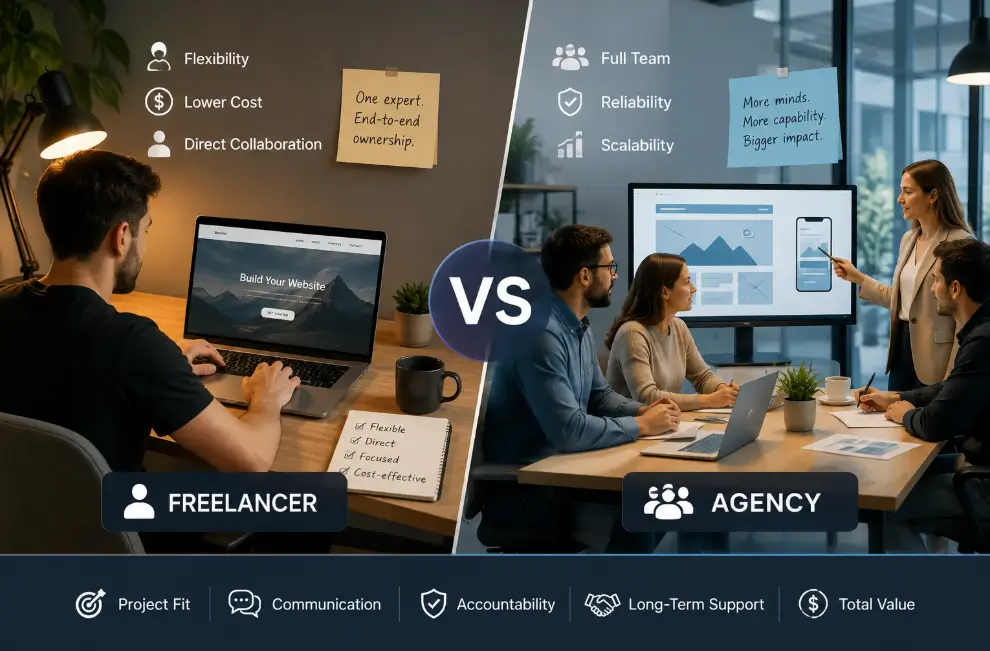
Key Takeaways
- The real difference isn’t price — it’s structure. A freelancer is one primary person; an agency is a structured team. Everything else follows from that.
- A freelancer usually suits a clear, simple scope with a tight budget and a preference for working directly with the person doing the work.
- An agency usually earns its higher fee when a project needs multiple disciplines at once, tight deadlines that require parallel work, or structured ongoing support.
- Provider type doesn’t guarantee quality. A strong freelancer can outperform a weak agency — judge the specific provider, not the label.
- Realistic Australian pricing spans a very wide range. Treat published figures as indicative and compare scope, not headline numbers.
The Quick Answer
Choose a freelancer when your scope is clear and the project is relatively simple, when budget matters, when you want to work directly with the person doing the work, or when you need a specific specialist. Choose an agency when the project spans multiple disciplines, involves ecommerce or custom integrations, has multiple stakeholders, faces deadlines that need parallel work, or when the website is business-critical and you want structured ongoing support.
And one point worth repeating before anything else: provider type itself does not guarantee quality. A great freelancer with a decade of experience and a trusted network can out-deliver a mediocre agency — and a skilled boutique studio can sit comfortably between the two. The type of provider narrows your options; the specific provider you choose decides the outcome.
The Real Difference: Delivery Model, Not Price
Most comparisons frame this as “freelancers are cheap, agencies are expensive.” That framing misses the point. The real difference is structural, and price is just the first consequence of it.
A freelancer is one primary person: you’re hiring an individual, and the project is shaped by that person’s skills, availability and working style. An agency is a structured team of specialists — designers, developers, strategists, writers and project managers — coordinated around a process. Neither structure is inherently better; each changes what a project can contain, how it gets done, what it costs and what happens after launch. The sections below trace how that structural difference shows up across the factors that actually decide your experience.
Freelancer vs Agency: The Side-by-Side
The table below maps the two models across the factors that matter most. The final column is the one to read carefully — it tells you when each difference will actually affect your project.
| Factor | Freelancer | Agency | What it means for you |
|---|---|---|---|
| Cost | Typically lower; fewer overheads to cover | Typically higher; you pay for a team and structure | Matters most when budget is the binding constraint |
| Scope & complexity | Best with clear, contained scope | Built to handle larger, multi-part scope | Matters most with ecommerce, integrations or custom builds |
| Expertise | One generalist, or a deep specialist | Several disciplines under one roof | Matters most when the project spans design, code, SEO and content |
| Capacity & deadlines | One person’s time; work often sequential | Parallel work across a team | Matters most when a tight deadline can’t be met by one person |
| Communication | Usually direct to the person doing the work | Often via a project or account manager | Matters most if you value direct access over structured handoffs |
| Accountability | One person owns the whole outcome | The organisation stands behind the work | Matters most when continuity after the project is important |
| Ongoing support | Varies; often ad-hoc or a simple care plan | Often a defined retainer or support level | Matters most if you need predictable help after launch |
| Risk profile | Single-person dependency | Organisational overhead and handoffs | Matters most for business-critical websites with little tolerance for gaps |
Notice what the table doesn’t say: it doesn’t say either model is “better.” It says each structure shifts where the advantages and risks sit — and which shift matters depends entirely on your project.
Cost: The Wildly Different Price Bands
The headline gap between the two models is real, but the specific numbers vary enormously depending on the source — which is itself worth knowing. Published ranges for a freelance-built small business website commonly run roughly $1,500–$6,000, while agency-built sites of comparable scope are commonly quoted from about $4,000–$15,000+ (the ranges used across our small business web design guide and our DIY vs professional comparison, compiled from published Australian provider pricing). Larger or more complex builds push well beyond both bands.
Look further across the market and the spread widens again. One Australian agency’s own comparison lists agencies from about $5,000 to $50,000+ and freelancers from around $2,000, depending on seniority and scope (Spark Interact). A pricing aggregator puts most small-to-medium business sites between $1,000 and $15,000+, with simple brochure sites at the bottom (Bark Australia). The common thread is direction, not precision: freelancers are usually cheaper, and the gap is smaller at the simple end of the market and widens as complexity rises.
Here’s the cautionary detail worth keeping in mind: even a single provider doesn’t always agree with itself. Spark Interact’s agency-vs-freelancer page lists freelancer hourly rates around $75–$150 and agencies around $150–$300 (Spark Interact), while their separate cost guide quotes freelancers at $50–$150/hour and agencies at $80–$200/hour (Spark Interact cost guide). Two pages, one company, different ranges. That’s a practical reminder of why you shouldn’t rely on any single “average web design price” — the range is real, the averages are noise.
So what actually drives the number? Almost every factor that adds scope or risk:
- Number of pages — more pages, more design, more content, more testing.
- Custom design versus templates — bespoke work costs more than adapting a theme.
- Ecommerce and payment systems — product catalogues, checkout, payment gateways.
- Integrations — CRMs, booking systems, APIs, client portals.
- Custom development — anything that isn’t off the shelf.
- Content, SEO and CRO — copywriting, technical setup, conversion work.
- Experience and team size — senior people and more hands cost more.
- Ongoing support — what happens after launch is a separate decision and a separate budget line.
If you want to know how the difference shows up in the paperwork, our guide to web design contracts covers how ownership, exit and handover clauses vary between the two models.
Scope & Complexity: What “Complex” Actually Means
”Complex projects need agencies” is the most common line in this debate — and it’s only half true. The useful question is what makes a project complex in the first place.
Complexity isn’t mostly about size. It’s about how many moving parts have to work together: an online store with payments and inventory, a booking system wired to a CRM, a bilingual site with custom functionality, integrations with third-party tools, or a design that must be handed to a developer and then to an SEO specialist without losing anything in translation. Each of those adds a coordination requirement — someone has to keep the pieces aligned.
Here’s the important nuance: complexity raises the coordination requirement, not automatically the quality of the work. A genuinely excellent freelancer with trusted collaborators — a writer they always use, a developer they subcontract, a specialist they call in — can absolutely deliver a complex project. What you’re really choosing is who carries the coordination load: the freelancer, the agency’s project manager, or (if you coordinate separate hires yourself) you.
For a breakdown of the build itself, our guide to what small business web design includes explains the components that drive both cost and complexity.
Expertise & Capacity: One Person vs a Team
It’s easy to assume an agency is automatically more skilled because it has more titles on the wall. That assumption deserves scrutiny. An agency can bring a designer, developer, SEO specialist, copywriter and strategist to a project — but it’s worth asking how senior each role actually is, and whether the people who pitched you are the people who will do the work. Meanwhile a freelancer is usually either a generalist, a deep specialist in one thing, or a specialist with a trusted network — and a specialist who does one thing extremely well can be the best possible hire for a project that needs exactly that thing.
The real structural advantage of a team is parallel capacity. When a project simultaneously needs design, development, content and SEO, a multi-person team can run those tracks in parallel instead of one after another. That matters most when a deadline is tight: a single person can only sequence so much work before the timeline breaks. For a project with a comfortable timeline, the sequencing constraint matters far less.
Communication: Who You Actually Talk To
Communication is where the two models trade one strength for another, and neither direction is universally right.
With a freelancer, you often speak directly with the person doing the work. There’s no message relay, no summary that loses detail — what you say reaches the person who builds the site. That’s a genuine advantage for owners who want to be hands-on and hate repeating themselves. Its flip side: the same person handles every question, so availability can be a bottleneck.
With an agency, communication is usually more structured: a project or account manager is your day-to-day contact, and specialist work happens in the background with handoffs between roles. Structured can mean better-organised and clearer processes; it can also mean more layers between you and the person writing your code. The right choice depends on whether you’d rather talk to the worker or to a coordinator.
The pattern that matters most is how communication works before you pay — because that’s usually the best-case version. Our guide to web designer red flags covers how to read those signals.
Risk & Accountability: Two Different Failure Modes
Both models carry risk, but the risks are different — and naming them honestly beats repeating the usual stereotypes.
With a freelancer, the risk is single-person dependency. Your project lives or dies with one person’s availability. If they’re ill, on leave, or simply stretched, progress stalls. The mitigations are practical and should be settled up front: what happens if they’re unavailable, who holds the documentation and account access, whether backups and handover are arranged, and how continuity is handled if you part ways. These are the same ownership questions every provider should answer, and they’re worth confirming in writing.
With an agency, the risk is organisational overhead and handoff dependency. Because work passes between roles, things can get lost in transition — and the person who pitched you may not be the person who builds your site. The mitigations: confirm who actually does the work, who your day-to-day contact is, what happens if your account manager changes, how issues escalate, and what’s handled in-house versus outsourced.
Neither dependency makes the provider “bad” — both are structural, and both are manageable with the right questions. The deeper question of what to look out for when hiring anyone is covered in our guide to web designer red flags, which lists the warning signs that apply regardless of provider type.
Ongoing Support After Launch
Build cost and ongoing support are separate decisions — and the second one is too often an afterthought. A website isn’t finished at launch: it needs updates, security, backups, hosting, occasional fixes, and eventually new features or SEO work. Who handles that, and under what arrangement, should be decided before you commit.
Freelancers typically offer ad-hoc support or a simple care plan, which can be perfectly adequate for a site that changes rarely. Agencies more often offer defined retainers with service levels — which matters when your site is business-critical and you need a predictable response. The right fit depends on how much your site changes and how much downtime would cost you.
For the full picture of what ongoing care costs and what it buys — including how the two models compare on maintenance delivery — see our guide to website maintenance costs in Australia.
The Third Paths: Boutique Studios, Networks and Hybrids
The market isn’t just two extremes. Three other setups are common, and each can be the right answer.
- Boutique studio. A small team — often two to five people — that aims for agency-grade quality with a more personal working relationship. It typically sits between a solo freelancer and a large agency on cost, capacity and process. For many small businesses, this is the middle path that fits best.
- Freelancer with a specialist network. A lead freelancer who coordinates trusted collaborators — a writer, a developer, a specialist — rather than doing everything alone. This gives you most of the benefits of a small team with a single point of contact. (For the separate question of what each role actually does, see our web designer vs web developer comparison.)
- Hybrid arrangements. For example, an agency builds the site and a freelancer maintains it afterwards, or a specialist contractor handles a specific piece of an internal team’s work. Hybrids can work well, but they raise the coordination question again: someone has to keep the parties aligned, and that someone is often you.
The point of listing these isn’t to say one is best — it’s to make clear that “freelancer or agency” is a useful starting question, not the whole decision. Whether a boutique studio, a networked freelancer or a hybrid serves you better depends on the same factors as the binary choice: scope, budget, communication preferences and support needs.
The Decision Framework
Choose a freelancer when…
- Your scope is clear and the project is relatively simple.
- Budget is a genuine constraint and the value of direct collaboration is high.
- You want to work directly with the person doing the work.
- You need a specific specialist skill that one expert can deliver.
- Post-launch requirements are limited and ad-hoc support is enough.
Choose an agency when…
- The project spans multiple disciplines — design, development, content, SEO, CRO.
- Ecommerce or custom integrations are involved and need to work together.
- Multiple stakeholders need to be managed and kept aligned.
- A deadline requires parallel work that one person can’t deliver.
- Structured ongoing support with defined service levels matters.
- The website is business-critical and downtime has a real cost.
Either can work when…
Provider type doesn’t guarantee quality. The deciding factors are the ones that apply to every provider, whichever label they use: relevant experience in projects like yours, a clear process, honest communication, confirmed ownership of your site and accounts, scope written down in a contract, a defined approach to support, and evidence of previous work you can actually inspect. Judge those, not the category. Our guide to how to choose a web designer walks through exactly how to assess a provider against those criteria — the decision framework here tells you which type to consider, and that guide tells you how to pick the right one within it.
Questions to Ask Each Type
Beyond the standard questions every provider should answer, each model deserves a few type-specific ones.
Ask a freelancer:
- What happens if you’re unavailable for more than a few days — is there coverage?
- Do you use subcontractors, and who would actually do the work?
- Who owns and controls the domain, hosting and accounts?
- What support is available after launch, and what does it cost?
Ask an agency:
- Who will actually work on my project — and will I meet them?
- Will I speak directly with specialists, or only with an account manager?
- Who is my day-to-day contact, and what happens if they change?
- What is handled in-house versus outsourced?
- How do issues escalate, and how quickly can I expect responses?
For the full checklist of questions to ask any web designer before signing — covering scope, pricing, ownership, revisions and support — see our complete guide to questions to ask a web designer.
Australia-Specific Considerations
A few factors are worth weighing specifically in the Australian context.
Compare quotes GST-inclusive. Australian registered businesses add 10% GST to their invoices, so a “$3,000” and a “$3,300” quote may be the same price depending on what’s included. Always confirm whether a quoted figure includes GST before you compare two providers. Our guide to comparing web design quotes gives the full method for lining two quotes up fairly.
AUD pricing varies by location and provider type. The indicative ranges in this guide are Australian dollars; the same scope quoted by an interstate or overseas provider can differ significantly. Our Adelaide web design cost guide gives local figures.
Ownership is about your accounts, not the provider. Whether you hire a freelancer or an agency, your domain and hosting should be in your name — a point our web designer red flags guide covers in detail, and one that applies equally to both models.
Local versus remote is a separate axis. A local provider shares your time zone and a local reputation to uphold; a remote provider may offer a wider talent pool or lower rates. The local-versus-remote decision cuts across the freelancer-versus-agency one, and our guide to how to choose a web designer weighs it directly.
Frequently Asked Questions
Is a freelancer cheaper than a web design agency?
Usually, yes — freelancers typically quote lower for comparable scope because they carry fewer overheads. Published Australian ranges commonly put freelance-built small business sites around $1,500–$6,000 and agency-built sites from about $4,000–$15,000+, with wide variation. But the cheaper headline doesn’t always mean a cheaper outcome: compare what’s included, how revisions are handled, and what happens after launch before you judge value.
What’s the risk of hiring a freelance web designer?
The main risk is single-person dependency — your project depends on one person’s availability and continued involvement. It’s manageable: confirm coverage for illness or leave, insist that domain and hosting are in your name, and get documentation and ownership in writing. These are structural risks, not reasons to avoid freelancers entirely.
Can a freelancer handle everything an agency can?
A strong freelancer can deliver a surprising amount — including complex projects, by coordinating trusted collaborators. The practical limit is parallel capacity: when a project needs several disciplines at once under a hard deadline, a single person can only sequence so much. Complexity raises the coordination requirement, not automatically the quality of the work.
Do freelance web designers offer ongoing support?
Many do, usually as ad-hoc support or a simple care plan covering updates, backups and small fixes. The difference from an agency is typically structure: agencies more often sell defined retainers with service levels and response commitments. Choose based on how much your site changes and how much downtime would cost you.
When should I choose an agency over a freelancer?
Choose an agency when the project spans multiple disciplines, involves ecommerce or custom integrations, has multiple stakeholders, faces a deadline that requires parallel work, or when the website is business-critical and you want structured ongoing support. For a clear, simple scope on a tight budget, a freelancer is often the better fit.
How much does a freelance web designer cost in Australia?
Indicative published ranges put a freelance-built small business website around $1,500–$6,000, with simple sites at the bottom and complex or ecommerce builds well above. Hourly rates are commonly quoted around $50–$150. Treat these as ranges, not an average — the right number depends on pages, custom design, integrations, content and ongoing support.
Conclusion
The freelancer-versus-agency decision isn’t a contest with a winner. It’s a choice between two delivery models with different structures — and the right one depends on your scope, budget, communication preferences, support needs and tolerance for risk. A freelancer is often the smart choice for a clear, simple project; an agency earns its fee when complexity, deadlines or ongoing support demand a team; and boutique studios, networked freelancers and hybrid arrangements sit between them. In every case, judge the specific provider by experience, process, communication, ownership and evidence — not by the label. Our guide to how to choose a web designer shows you how.
If you’d like an honest read on which setup fits your project — including when the answer is a freelancer, a different provider type, or no professional at all — start a conversation. We’ll help you clarify your scope and requirements before you spend anything. And if you’d like to see how one provider structures its work and pricing, our service pricing is available any time.
