

The quote is agreed, the price is right, and you’re about to sign. That’s exactly when most small businesses stop reading and start trusting. Then the project stalls, the designer holds your admin access, or every change is billed as an extra. And the contract that could have protected you turns out to have been protecting them instead. A web design contract isn’t a formality. It’s the document that decides what you own, what you pay, and what happens when things go wrong.
This guide walks through the clauses that matter in a web design contract in Australia, written for small business owners who are ready to sign but not sure what they’re agreeing to. If you’re still earlier in the process, our guide to how to choose a web designer covers vetting the provider, and questions to ask a web designer covers the pre-sign interview. This article is the clause-by-clause companion: what a healthy contract looks like, who owns what by default under Australian law, and where the real red flags hide.
Key Takeaways
- Under Australian law, the designer owns the work they create by default unless the contract says otherwise, so who owns your website must be negotiated in writing, before you pay.
- A complete web design contract covers scope, ownership, payment milestones, revisions, timeline, content, exit and handover. Eight clauses, none optional.
- There’s no legal cap on deposits in Australia. Negotiate milestone payments tied to deliverables instead of trusting any percentage.
- Australian consumer guarantees can’t be signed away, and unfair terms can be void for small businesses; some terms in the contract may not even be enforceable.
- This article is practical guidance, not legal advice. If a contract is large or confusing, take our lawyer checklist to a professional.
Why the Contract Matters More Than the Quote
The quote tells you the price. The contract tells you everything else: what the price actually buys, how changes are billed, who owns the result, and what happens if either side walks away. Two identical prices can produce completely different outcomes depending on what’s written around them. A contract that’s silent on ownership, revisions or exit isn’t neutral; it silently resolves each of those questions in the designer’s favour.
That’s why the comparison you do before signing matters so much. If you’re holding quotations from different providers, line them up on a consistent scope first; our guide to comparing web design quotes shows how. Once you’ve picked a provider, the contract is where fairness is made enforceable, or given away.
The 8 Clauses Every Web Design Contract Should Have
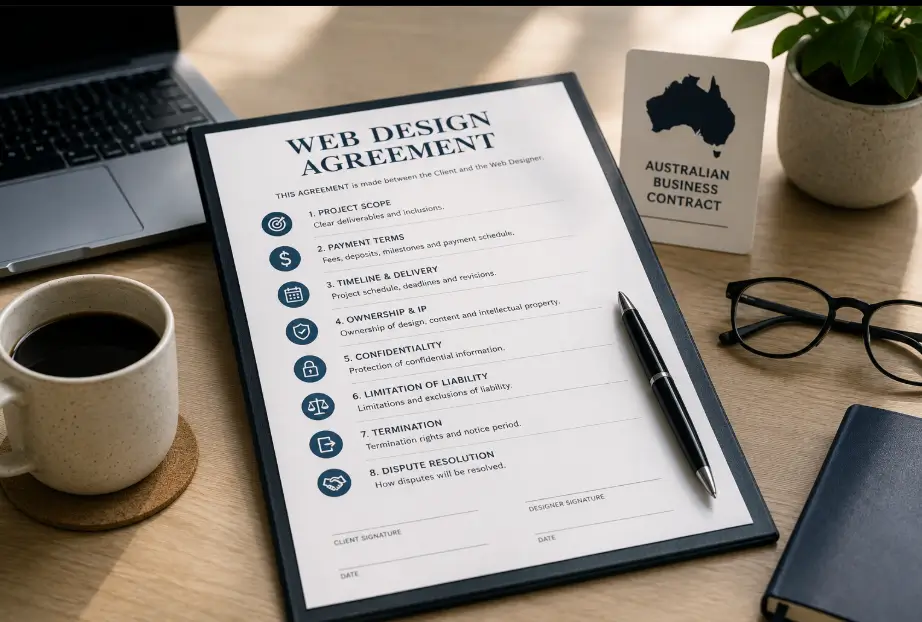
Here’s the checklist. A contract that covers these eight areas in plain language is one you can sign with confidence. A contract that skips or blurrifies any of them has a gap you should close before signing.
1. Scope and deliverables
Exactly what’s being built: the number of pages, the platform, the design approach, which features are included, and just as importantly, what’s not. “Website design and development” with no detail is the most expensive sentence in the English language, because it lets every later question be answered with “not included.”
2. IP and ownership
Who owns the design, the code, the content and the domain when the project ends. In Australia the default is not in your favour; the next section explains why. So this clause needs to state, in writing, that ownership transfers to you on final payment. If you’re already past signing and want to know who currently owns each asset and how to transfer it, our guide to who owns your website walks through the audit and the transfer process.
3. Payment terms and milestones
What you pay when. A schedule tied to deliverables, a portion on design approval, a portion on build completion, the balance on launch, rather than a single upfront payment.
4. Revisions and change control
How many rounds of design revisions are included, what counts as a revision, and how out-of-scope changes are quoted. Without this, every tweak is an invoice waiting to happen.
5. Timeline and delays
Delivery dates with reasonable buffers, and what happens if the designer (or you) falls behind. A timeline that’s one fixed date with no delay mechanism leaves both sides with nowhere to go. For a sense of what’s realistic at each stage before you negotiate dates, our guide to the web design process walks through the typical sequence and timings.
6. Content and assets
Who supplies the copy, images and branding, and who’s responsible if third-party assets have licensing problems. Content responsibility is the most common silent gap between what you expect and what’s included.
7. Exit and termination
How either side can end the agreement, what you owe up to that point, and what happens to the work in progress. A contract with no exit clause is a contract you can’t leave.
8. Support, maintenance and handover
What happens after launch: a bug-fix period, any maintenance plan, and the handover of admin access, source files and documentation. Practitioners commonly cite 30 to 90 days as the norm for a post-launch bug-fix window; treat that as a reference point, not a rule.
IP and Ownership: In Writing, Before You Pay
This is the single most important clause for Australian small businesses, because the default legal position is not the one most people assume. According to IP Australia’s guidance on who owns IP, “IP created by a contractor is the property of the contractor unless otherwise stated in the contract” (IP Australia, “Who owns intellectual property?”). In plain terms: unless the contract explicitly transfers it to you, the designer owns the design and code they create. A handshake, an email, or a promise won’t fix that after the fact.
What transfer of ownership should cover: the design and graphics, the source code, the written content once you’ve paid for it, the domain name registration, the hosting account, and all admin access to the CMS and third-party tools (analytics, search console, booking systems). The contract should say the transfer happens on final payment, not “after the project is complete, arrangements may be discussed.”
The enforcement point is timing: get this written and signed before you pay the first deposit. Once money has moved, the designer has far less incentive to change the ownership terms. If the contract is silent on IP but you’re being asked to sign and pay, ask for the ownership clause to be added; a professional won’t hesitate.
If you want to go deeper on what to actually audit and transfer when the time comes, the domain, hosting and content handover mechanics, that’s the subject we’ll cover in our upcoming guide on who owns your website. Here we’re focusing on how to write ownership into the contract itself.
Payment Terms, Milestones and Deposits (Australia)
Australian law doesn’t cap what deposit a web designer can ask for; it’s a matter for negotiation between you and the provider. What you can control is the structure, and structure matters far more than the percentage. Milestone-based payments tied to deliverables, a payment on design approval, a payment when development completes, the balance on launch, protect you because you only ever pay for work you’ve actually received. That’s stronger protection than any deposit number.
If you do see community advice citing typical deposits, treat the numbers as anecdotes rather than rules: practices range from small deposits of 10 to 20 percent of the project to 50 percent upfront treated as routine. What matters isn’t the number, it’s whether the payment schedule is linked to visible milestones and whether it’s on the same page as the scope.
Once you’re registered or paying for a contract, also confirm the GST treatment in writing. GST in Australia is 10%, and GST-registered businesses can generally claim the GST back on purchases for their business, so the contract should state whether prices are inclusive or exclusive of GST, and show the GST-inclusive total as a single number. A single quick check: the GST portion of an inclusive price is one-eleventh of the total.
Revisions, Scope Creep and Delays
Most budget blowouts in web design projects don’t come from the build price; they come from changes billed as extras and projects that drag on without a mechanism to finish. Three clauses keep that under control.
Revision rounds. The contract should state how many rounds of design revisions are included (a common practitioner norm is two to three rounds before changes are priced as extras; treat that as a reference point, not a rule), what counts as a revision round, and what additional work costs. Without a number, “I’ll make it right” becomes an open invoicing tap.
Change control. Out-of-scope requests, a new page, a new integration, a moved deadline, should go through a written change request that states the cost before work begins. The contract should say that out-of-scope work is quoted and agreed in writing, not assumed.
Delays, both directions. A healthy contract acknowledges that delays are rarely one-sided. It gives the designer a reasonable-time standard and allows legitimate slippage, but also sets expectations on you: if you take weeks to review designs or supply content, that delay shifts the timeline accordingly. If you want to know what to ask about all of this before you sign, our questions to ask a web designer guide has the exact phrases.
Exit, Termination and Handover
The clause you’ll only read properly when things go wrong is exit and termination, and it’s the one most worth understanding in advance. It should answer: how can either side end the agreement, what is owed up to that point, and what happens to the work in progress?
What you owe on exit. A fair contract ties what you owe to work actually delivered: you pay for completed, accepted milestones, not for the projected remainder of a project you’re leaving. Watch for exit clauses that demand full payment regardless of progress; they’re designed to make leaving too expensive to attempt.
What you take with you. If the project ends, early or at completion, you should be able to take what you’ve paid for: the work completed to date, and for an ended project, whatever is needed to continue elsewhere. If you’ve negotiated ownership correctly, the handover clause confirms you receive source files, content, domain access and admin credentials on exit. A contract that’s silent here leaves your website trapped on someone else’s account, and if that provider later stops responding, our guide to taking back a website from a disappeared designer covers the recovery route.
A handover that’s part of the project. Even for a successful project, handover belongs in the contract: a defined transfer of keys and documentation at sign-off. Our comparison guide to freelancers versus web design agencies notes how handover expectations differ between the two provider types, worth knowing whichever you sign with.
Australian Context: ACL and IP Australia
Two Australian legal realities shape what any web design contract can and can’t do, and they apply automatically; you don’t need to negotiate them, but you should know they exist.
Consumer guarantees can’t be signed away. Services you buy are covered by the Australian Consumer Law’s consumer guarantees where the purchase is under $100,000 (GST-inclusive, or a kind ordinarily acquired for personal, domestic or household use). The guarantees mean services must be provided with due care and skill, be fit for any purpose you made known, and be delivered within a reasonable time. And if there’s a major failure, you can choose the remedy, including cancelling and getting a refund for the undelivered portion. No clause in a contract can waive these guarantees. If a contract asks you to sign away your rights, that part won’t protect the designer in the way it appears. The ACCC’s guidance on consumer guarantees explains what applies to business purchases.
Unfair contract terms can be void. For small businesses (generally under 100 employees or an annual turnover under $10 million), the Australian Consumer Law protects against unfair contract terms in standard-form contracts. A term can be unfair if it’s not reasonably necessary to protect the legitimate interests of the party relying on it, and would cause a significant imbalance in your rights. Translated into web design: a clause that lets the designer terminate at will while leaving you fully liable, or that denies you any remedy you’d otherwise have, may be unenforceable rather than merely annoying. The ACCC’s guidance on contracts and agreements covers offer, acceptance and unfair terms.
IP Australia and contractors. As covered above, IP Australia’s default position is that a contractor owns what they create unless the contract transfers it, which is exactly why the ownership clause is decided in writing, not by silence. One honest note: this guide is practical advice for small business owners, not legal advice. If a contract is long, or the value is high, spending a small amount on a lawyer is insurance, not expense.
Contract Red Flags
These are warning signs inside the document itself, a document-level companion to the provider-behaviour red flags in our guide to web designer red flags. Watch for:
- No IP transfer clause. Under Australian default rules, this means you may not own your own website. Non-negotiable; ask for it in writing.
- Ownership tied to after you’ve paid everything. If transfer only happens at final payment and there are no milestones, you’re paying full freight for a site you don’t yet own.
- No scope definition. “Website design and development” with no page list, platform or inclusions. Every later dispute starts here.
- No revision number. Unlimited-sounding promises (“we’ll keep at it until you’re happy”) usually become billed extras.
- One-sided termination. The designer can exit at any time, but you’re locked in, or you owe the full balance on any termination.
- No handover obligations. If the project ends or completes, there’s no obligation to give you files and access.
- ”Waiving” your legal rights. Clauses that try to exclude Australian consumer guarantees, or deny any remedy for faulty work, are at best unreliable and at worst void.
- A template that doesn’t name you. A generic contract with the wrong business name, the wrong platform, or blank fields is a contract you can’t enforce.
One red flag is worth a question. Several together are grounds to walk away before you sign.
Questions to Take to a Lawyer
If the contract exceeds your comfort level, take it (and this list) to a solicitor. These six questions turn an hour with a professional into maximum value:
- “Does this contract transfer full IP ownership to my business, and at what point in the payment schedule?"
- "What amount do I actually owe if I terminate partway through, based on the exit clause?"
- "Are there any unfair-contract-term risks in the termination or liability clauses, given my business size?"
- "Which consumer guarantees apply to this purchase, and does the contract try to exclude any of them?"
- "Does the handover clause guarantee I get my domain, hosting, admin access and source files?"
- "Is the revision and change-control wording clear enough to stop surprise invoicing?”
A solicitor reviewing a website contract is usually an hourly engagement, far cheaper than the alternative. If the contract is a reputable, standard document, the review will be quick, and you’ll have signed it with confidence rather than hope.
Frequently Asked Questions
Do I own my website if the contract doesn’t say?
Under IP Australia’s default rule, no; a contractor owns the IP they create unless the contract states otherwise. You should not rely on a verbal promise or an email. The ownership transfer must be written into the contract, explicitly listing the design, code, content, domain and admin access, with transfer effective on final payment.
Should I pay a web designer a deposit?
Some deposit is common, and Australian law doesn’t set a cap. The safer structure is milestone payments tied to deliverables, a portion on design approval, a portion on build, the balance at launch, so you only pay for work you’ve received. Whatever you agree, make sure the schedule is written into the contract, not just discussed.
Can a web design contract lock me into ongoing costs?
It can; hosting and maintenance terms are often bundled into exit clauses. That’s why the contract should state ongoing costs separately, whether they’re optional, and how to cancel them. For a small business, a clause that makes leaving a maintenance plan financially punishing may be reviewable as an unfair term.
Do Australian consumer guarantees apply to my business website?
Generally yes for purchases under $100,000 and for services of a kind ordinarily used personally or at home. Services must be provided with due care and skill, be fit for purpose, and be delivered within a reasonable time, and major failures carry remedies you can choose. These guarantees can’t be excluded by the contract.
What happens to my website if the designer disappears or refuses handover?
That depends almost entirely on what’s written about ownership and handover. If the contract transfers ownership and requires handover of files, domain and admin access, you have a legal entitlement to take the site with you. If it’s silent, the default position under IP Australia’s rules works against you, which is why those clauses must be in writing before you pay.
Conclusion: Read the Clauses Before You Sign
A web design contract protects you exactly as much as you’re willing to read it. Run through the eight clauses, make sure ownership is in writing and effective before everything’s paid, structure payments around milestones, and treat any clause that short-circuits your legal rights as a signal. The contract is the last line of defence before a project goes well, or badly.
If you’d like an agreement that survives this checklist, our custom website development service uses plain-language contracts with exactly these clauses: ownership on final payment, milestone billing, capped revisions and a defined handover. Tell us about your project and we’ll send you a proposal that’s built to be read.
